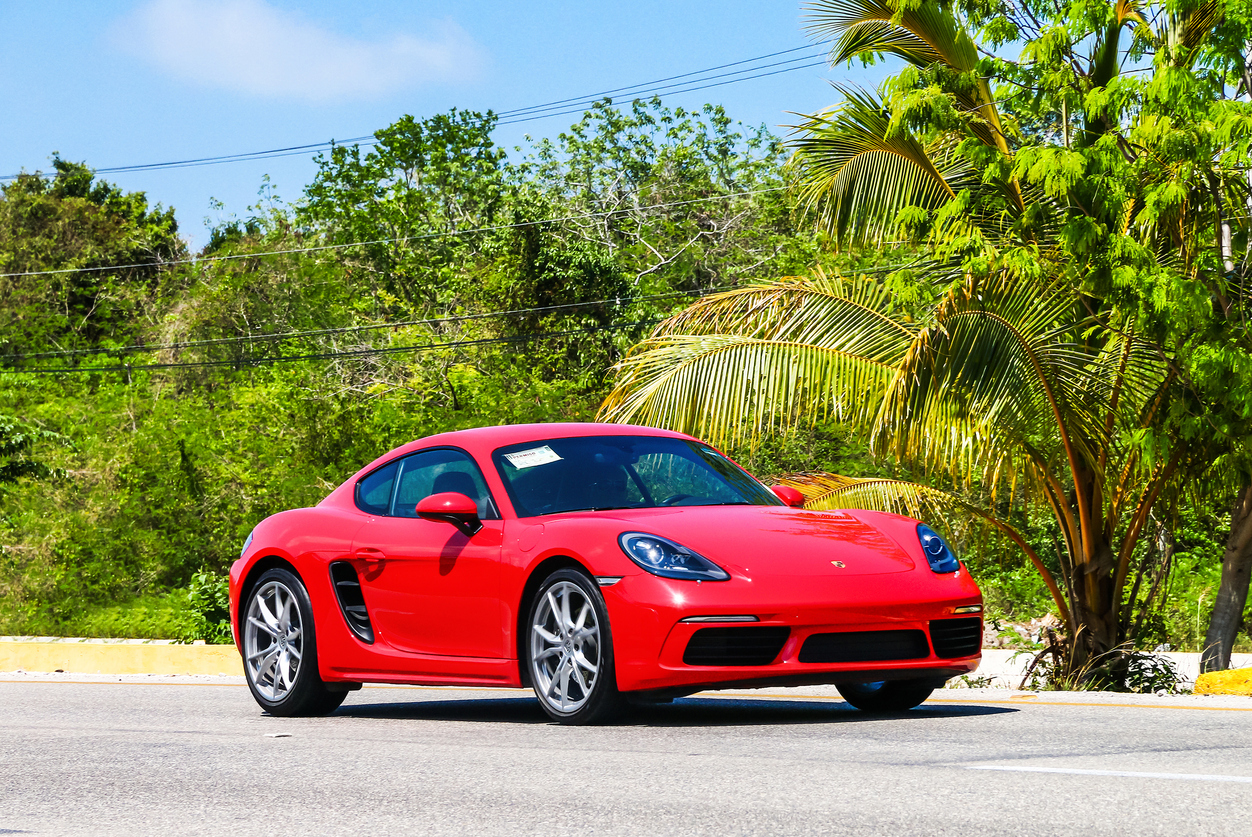
Porsche Boxster & Cayman Buyer's Guide
Mid-engine layout, near-perfect weight distribution, and historically undervalued relative to the 911. From the budget-friendly 986 to the flat-four 718 debate, here is everything you need to know.
Overview
The Porsche Boxster and Cayman occupy a unique position in the sports car world: they are mid-engined Porsches with weight distribution advantages that even the 911 cannot match. The mid-engine layout places the heavy flat-six behind the seats and ahead of the rear axle, resulting in near-neutral balance that makes the car more predictable and forgiving at the limit than the 911's rear-engine configuration.
For years, these cars were undervalued in the used market — buyers overlooked them in favor of the 911's cachet. That discount has been shrinking as enthusiasts increasingly appreciate what the Boxster and Cayman offer. A 987.2 Cayman S or 981 GT4 at today's prices represents some of the best driver's car value available.
The Cayman was introduced for the 987 generation as a fixed-roof coupe version of the Boxster. While both share platforms and engines, the Cayman's stiffer body structure gives it a slight handling edge, and its superior aerodynamics make it the choice for driving purists. The Boxster, as a roadster, offers open-air motoring as a genuine trade-off consideration.
Generation Breakdown
Boxster 986 — The Budget Entry Point
The original water-cooled Porsche mid-engine car. Shared the M96 engine and its IMS bearing with the 996 Carrera. Styling was original and praised upon launch. The 986 is the most affordable way into Porsche ownership, with good examples still available under $15,000. All IMS concerns from the 996 guide apply. The 986 S arrived in 2000 with a 3.2-liter engine producing 252 hp. Budget for the IMS retrofit ($2,000–$2,800) when buying any 986.
Boxster & Cayman 987.1 — Improved Styling, Same IMS
The 987.1 redesigned the Boxster with crisper, more modern styling and introduced the Cayman as a coupe variant. The engines were updated but the fundamental M97 architecture retained the IMS bearing. The Cayman S with its 3.4-liter engine and 295 hp is an excellent driver's car. Again, IMS retrofit is essential — same advice as the 986 applies. These cars are now fully depreciated, making a well-maintained 987.1 S with IMS done a strong value proposition.
Boxster & Cayman 987.2 — The Sweet Spot
Porsche switched to a new direct injection (DFI) engine for the 987.2, completely eliminating the IMS bearing. The new engines are also more powerful: 255 hp in the base and 320 hp in the S. The 987.2 represents the ideal combination of affordable price, clean driving dynamics, and eliminated IMS risk. For buyers who want a flat-six mid-engine Porsche without the IMS concern at the lowest possible price, the 987.2 S is the answer. Values have risen but remain reasonable.
Boxster & Cayman 981 — Last of the NA Flat-Six Mid-Engine
The 981 represents the final iteration of the naturally aspirated flat-six mid-engine formula before the 718's turbocharged flat-four. The 981 Cayman S produces 325 hp and is widely regarded as one of the best driver's cars at any price. The 981 GT4 — introduced for the final model year — uses the 911 Carrera S engine producing 385 hp and represents the pinnacle of the naturally aspirated mid-engine experience. GT4 values are strong and have appreciated significantly from original retail pricing.
718 Boxster & Cayman — The Flat-Four Era
The 718 switched from the flat-six to a 2.0-liter or 2.5-liter turbocharged flat-four. Performance improved — the 718 S is genuinely fast — but the engine sound and character are polarizing. Porsche responded with the GTS 4.0 and GT4 variants that use a 4.0-liter naturally aspirated flat-six, effectively creating two distinct character points within the same generation. The GT4 RS (2021+) takes this further with 500 hp. No IMS risk on any 718 variant.
The 718 Flat-Four Debate
When Porsche replaced the flat-six with a turbocharged flat-four in the 718, the backlash from enthusiasts was significant. The debate continues today and is worth understanding before making a purchase decision.
The flat-four's arguments are straightforward: the 2.5-liter turbocharged unit in the S produces 350 hp and 310 lb-ft of torque, more than the outgoing 3.4-liter flat-six it replaced. It is faster by every objective measure and more fuel-efficient. The power is accessible lower in the rev range, making it easier to drive quickly on public roads.
The objections center on character. The flat-four has a coarser sound at low RPM — some owners describe it as sounding unlike a Porsche. The linear, high-revving character of the naturally aspirated flat-six is replaced by turbo torque that builds and delivers differently. The engine note through the cabin drew criticism sufficient that Porsche introduced a sound symposer on some variants to pipe in more noise. Whether you find the flat-four sounds acceptable, or find it actively off-putting, is highly personal. Test drive both before deciding.
The GTS 4.0 and GT4 Response
Porsche clearly heard the feedback. In 2020, the 718 GTS 4.0, Spyder, and GT4 introduced a 4.0-liter naturally aspirated flat-six producing 394–420 hp. These cars are everything the NA flat-six faithful wanted: high revving, fantastic sound, sharp chassis, and genuinely fast. The GT4 RS pushes to 500 hp with motorsport-derived technology. For buyers who want a 718 but specifically want the flat-six, these are the variants to target. They command a premium over the flat-four 718 but are widely considered worth it.
IMS Risk Summary by Generation
| Generation | Years | Engine | IMS Bearing Risk | Recommendation |
|---|---|---|---|---|
| 986 Boxster | 1997–2004 | M96, 2.5/2.7/3.2L | Yes ⚠ | IMS retrofit required |
| 987.1 Boxster/Cayman | 2005–2008 | M97, 2.7/3.4L | Yes ⚠ | IMS retrofit required |
| 987.2 Boxster/Cayman | 2009–2012 | MA1 DFI, 2.9/3.4L | No ✓ | No IMS concern |
| 981 Boxster/Cayman | 2012–2016 | NA, 2.7/3.4L | No ✓ | No IMS concern |
| 718 Boxster/Cayman | 2017+ | Flat-4 TT / NA F6 | No ✓ | No IMS concern |
What to Inspect
Beyond the IMS considerations above, key inspection points for Boxster and Cayman purchases include:
- 986/987.1 IMS retrofit: Confirm with documentation. Same advice as the 996 guide — non-negotiable before purchase.
- 987.2 carbon buildup: Same DFI concern as the 997.2 — walnut blasting on higher-mileage examples. Not as urgent as IMS but worth confirming on high-mileage cars.
- Convertible top condition (Boxster): Inspect the convertible top for tears, proper sealing at the windscreen header, and correct operation of the electro-hydraulic mechanism. Top replacement is expensive — $3,000–$5,000 at an independent shop.
- Engine bay access (Boxster/Cayman): Mid-engine access is more limited than front-engine cars. Confirm the service records show proper maintenance was performed at intervals — some owners defer service due to the access inconvenience.
- Intermediate shaft oil feed (987.2/981): While IMS risk is eliminated, confirm regular oil changes were performed per Porsche intervals (10,000 miles or annually). DFI engines with extended oil change intervals can develop issues.
- 981 GT4 intake manifold: Early 981 GT4 and Spyder cars had intake manifold issues that could affect performance. Confirm any recall work was completed on those specific models.
- Coolant condition: Same advice as the 911 guides — pink/orange is correct, rusty brown indicates neglect.
Market Prices by Generation
| Model | Generation | IMS | Price Range |
|---|---|---|---|
| Boxster / Boxster S | 986 (1997–2004) | Yes | $10,000–$20,000 |
| Boxster / Cayman (S) | 987.1 (2005–2008) | Yes | $15,000–$28,000 |
| Boxster / Cayman (S) | 987.2 (2009–2012) | No | $20,000–$38,000 |
| Boxster / Cayman (S) | 981 (2012–2016) | No | $35,000–$60,000 |
| Cayman GT4 / Boxster Spyder | 981 (2015–2016) | No | $80,000–$130,000 |
| 718 Boxster / Cayman (S) | 718 (2017+) | No | $45,000–$80,000 |
| 718 GTS 4.0 / GT4 / Spyder | 718 (2020+) | No | $80,000–$140,000 |
| 718 GT4 RS | 718 (2022+) | No | $140,000–$180,000 |
Best Value Picks
987.2 Cayman S — The Flat-Six Sweet Spot
The 987.2 Cayman S combines all the right attributes: no IMS risk (new DFI engine), 320 hp naturally aspirated flat-six, the mid-engine handling balance that enthusiasts love, and prices that have not yet fully appreciated to 981-level premiums. A clean 987.2 Cayman S with proper service history in the $28,000–$36,000 range is one of the best driver's car values on the used market. Full stop.
981 GT4 — The Peak Mid-Engine Experience
If budget allows, the 981 GT4 is a car that will appreciate in value and remain relevant as a driver's car indefinitely. Using the 3.8-liter engine from the 991 Carrera S producing 385 hp, connected to the ground through the finest chassis in the lineup, the GT4 is the car Porsche would have built if they didn't have to worry about protecting the 911's market position. Prices have risen but a clean example with manageable miles in the $90,000–$105,000 range is still compelling given what these cars will be worth in ten years.
Ready to find your Boxster or Cayman? Browse live listings scored for deal quality across all major marketplaces.
Browse Boxster Listings →Buyer's Toolkit
Tools and supplies every Porsche buyer should have — before the purchase and after.
As an Amazon Associate, FlatSixFinder earns from qualifying purchases.