Porsche 992 Buyer's Guide (2019–Present)
The current-generation 911. No legacy reliability concerns, a fully digital cockpit, and the cleanest buying process of any modern 911 — but it commands a premium that demands careful specification shopping.
Overview
The 992 arrived in 2019 as the most technologically advanced 911 ever built. It carries no mechanical legacy concerns — no IMS bearing, no bore scoring risk, no recalled engine issues. The 3.0-liter twin-turbo flat-six underpinning the Carrera lineup is a fully mature unit carried over and refined from the 991.2, now producing 379 hp in Carrera form and 443 hp in Carrera S trim.
From the outside, the 992 is the widest and most muscular Carrera ever made — the rear haunches have been widened to match the Carrera 4's body from previous generations, giving all 992 Carreras an imposing stance. Inside, analog instruments are gone. The 992 introduces a 10.9-inch PCM touchscreen and a fully digital instrument cluster — a significant departure from previous 911 generations that defined themselves by the analog central tachometer.
992.1 vs. 992.2
The 992 mid-cycle refresh (992.2) arrived for the 2025 model year, introducing meaningful updates particularly in the GTS variants and GT3.
992.1 (2019–2024)
- Carrera: 3.0L TT, 379 hp
- Carrera S: 3.0L TT, 443 hp
- GTS: 3.0L TT, 473 hp
- GT3: 4.0L NA, 502 hp, 9,000 rpm
- Turbo S: 3.8L TT, 640 hp
- Transmission: 8-speed PDK or 7MT
- Cockpit: Digital, 10.9" PCM
992.2 (2025+)
- Carrera: 3.0L TT, 394 hp (+15 hp)
- Carrera S: 3.0L TT, 473 hp (+30 hp)
- GTS: T-Hybrid, 532 hp
- GT3: 4.0L NA, 9,000 rpm, revised
- Styling: Revised front fascia
- PDK: Updated 8-speed unit
- Value: Strong premium vs 992.1
Which 992 Should You Buy?
Carrera — The Entry Point
The base 992 Carrera is a remarkable car in isolation — 379 hp, 0–60 in 4.0 seconds with Sport Chrono, and the full 992 chassis experience. The practical argument against it: the Carrera S adds 64 hp and larger brakes for typically $10,000–$15,000 more on the used market. Most enthusiasts who drive both side-by-side opt for the S. That said, if budget is the priority, a well-specced base Carrera with key options (Sport Exhaust, Sport Chrono, PASM) is a satisfying car.
Carrera S — The Sweet Spot
The 992 Carrera S hits the performance/value crossover point in the lineup. 443 hp, larger PSCB-compatible brakes, wider rear tires standard, and enough pace to embarrass most sports cars in normal driving. On the used market, it sits at a price point that makes financial sense. This is the most recommended 992 for buyers who want genuine performance without Turbo S or GTS pricing.
GTS — The Connoisseur's Pick
The GTS adds 30 hp over the Carrera S (473 hp), Sport Exhaust standard, Sport Chrono standard, PASM Sport standard, and GTS-specific sport seats and interior badging. When you option a Carrera S to GTS spec, the price difference shrinks considerably — making the GTS excellent value when purchased used. It also holds its resale value better than the standard Carrera S. If you find a clean 992.1 GTS at a reasonable price, it is almost always the better buy.
Turbo S — Maximum 992
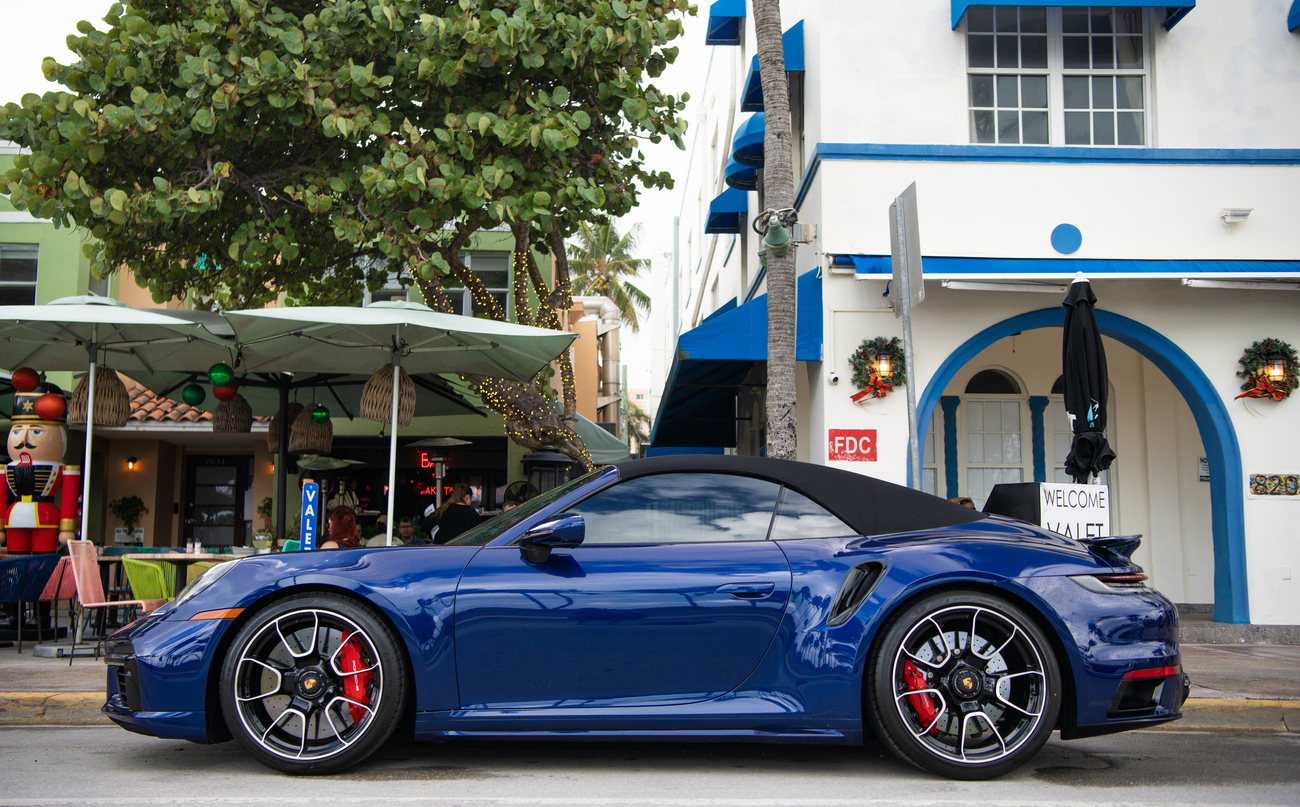
The Turbo S produces 640 hp, uses a wider 3.8-liter twin-turbo, all-wheel drive, and active aerodynamics. It is genuinely supercar-fast while remaining a daily driver. The price premium over the GTS is substantial — expect to pay $180,000–$230,000 for clean used examples — and it comes with Turbo S running costs (tires, brakes, services). The photo at the top of this guide shows a Turbo S Cabriolet, and represents the 992 at its most imposing.
GT3 — The Driver's Car
The 992 GT3 is the enthusiast prize of the generation. The 4.0-liter naturally aspirated flat-six revs to 9,000 rpm and produces 502 hp with a sound unlike any other modern sports car. Available in Coupe and Touring (no wing) variants, PDK or 6-speed manual. Manual GT3 examples command a significant premium and have essentially not depreciated. PDK GT3s offer slightly better lap times; the manual offers character the PDK cannot replicate.
The All-Digital Cockpit — What Changed
The 992 represents a complete break from the analog instrument philosophy that defined every previous 911. Buyers coming from a 991 or older will notice:
- No analog tachometer: The central tach — an iconic 911 design element — is now a digital display. It reads cleanly but divides opinion among traditionalists.
- 10.9-inch PCM: Porsche's infotainment touchscreen replaces the button-heavy PCM of older cars. It's fast, responsive, and supports Apple CarPlay and Android Auto. Software updates are over-the-air on later 992s.
- Sport Response Button: A new 20-second full-attack mode that pins throttle mapping and transmission to maximum response — a genuinely useful feature for track days or canyon runs.
- Wet Mode: The 992 detects standing water via acoustic sensors in the front wheel arches and pre-configures the stability systems accordingly. Clever and useful for daily driving.
Known Issues and What to Inspect
The 992 has no generation-defining mechanical flaw. Issues that do surface are primarily electronic:
- PCM software glitches: Occasional screen freezes or unresponsiveness. Almost always resolved by a software update at the dealer — not a mechanical concern.
- PDCC sensor faults: Some early 992s have reported Porsche Dynamic Chassis Control fault codes. Usually a sensor calibration issue, not a mechanical failure. Confirm it's been addressed in service history.
- PDK software: A small number of 992s had PDK calibration updates issued by Porsche as TSBs (Technical Service Bulletins). Ask the selling dealer or get a PPI to check for outstanding TSBs.
- Tire wear: 992 rear tires are wide and performance-compound. Under spirited driving they wear quickly. Check remaining tread depth — replacement cost is significant on PSCB-equipped cars.
- Brake rotor condition: On PCCB-equipped cars (ceramic composite brakes), rotor surface inspection is critical. Surface rust from sitting is normal but cracks are not. PCCB replacement costs are high.
- Service history: Given the 992's age, most examples should have complete dealer or Porsche specialist records. Gaps in service history on a car that should only be 1–5 years old are a significant red flag.
Ready to inspect a 992? Use FlatSixFinder's Listing Analyzer to cross-reference any 992 listing against real auction comps before you make an offer.
Analyze a Listing →Manual vs. PDK
The 992 is available with a 7-speed manual or 8-speed PDK across the Carrera lineup, and a 6-speed manual or PDK on the GT3.
PDK — The Objective Choice
- Faster 0–60 by 0.2–0.4 seconds across variants
- Better fuel economy in everyday driving
- Less fatiguing in heavy traffic
- Auto-blip on downshifts in Sport/Sport Plus
- Broader used market inventory
- Preferred by most track drivers
Manual — The Subjective Choice
- Stronger emotional connection for many drivers
- Premium resale value — especially on GT3
- Shorter final drive ratio = more responsive feel
- Simpler mechanically long-term
- Less common — harder to find but worth searching for
- Some prefer manual for road trips and canyons
Model Variants and Used Prices
| Model | Years | Power | Used Price Range (2025) |
|---|---|---|---|
| Carrera | 2019–2024 | 379 hp, 3.0L TT | $85,000–$105,000 |
| Carrera S | 2019–2024 | 443 hp, 3.0L TT | $100,000–$130,000 |
| Carrera 4S | 2019–2024 | 443 hp, AWD | $105,000–$135,000 |
| Carrera GTS | 2021–2024 | 473 hp, 3.0L TT | $130,000–$158,000 |
| Targa 4S | 2019–2024 | 443 hp, AWD | $110,000–$140,000 |
| GT3 | 2021–2024 | 502 hp, 4.0L NA | $180,000–$250,000 |
| GT3 RS | 2023–2024 | 518 hp, 4.0L NA | $275,000–$380,000 |
| Turbo S | 2020–2024 | 640 hp, 3.8L TT AWD | $185,000–$235,000 |
| Turbo S Cabriolet | 2020–2024 | 640 hp, 3.8L TT AWD | $195,000–$250,000 |
Options Worth Having
The 992 Porsche options list runs deep. These are the options that meaningfully affect the driving experience and/or resale value:
- Sport Chrono Package: Adds launch control, Sport Response Button, and Porsche Track Precision App. Near-essential on any performance-focused 992. Usually a $3,000–$4,000 option new.
- Sport Exhaust: Transforms the sound profile dramatically. Standard on GTS and above — if buying a base Carrera or Carrera S, verify it's equipped or expect a meaningful discount.
- PASM Sport (20mm lower): Worth having if the car sees any track use. Can be toggled off for daily driving comfort.
- Rear-Axle Steering: Makes the 992 feel more nimble at speed despite the wider body. Available as an option on Carrera S and above, standard on GTS. Adds measurable handling benefit.
- Bose / Burmester Sound: The Burmester option ($5,000+ new) is genuinely excellent. Matters more on Cabriolet variants where road and wind noise compete.
- Front-Axle Lift: Essential if the car lives anywhere with steep driveways or speed bumps. Standard on some packages — verify if it matters in your environment.
- Leather / Full Leather Interior: Well-optioned interiors hold value better and look significantly richer. Standard partial leather finishes age less gracefully.
Is the 992 Worth the Premium Over a 991?
This is the central question most buyers face. A 992 Carrera S typically costs $25,000–$40,000 more than a comparable 991.2 Carrera S. What does the premium buy you?
- More power: 443 hp vs. 420 hp — marginal in real driving
- Wider body standard: All 992 Carreras have the wider rear haunches
- Better infotainment: The 992 PCM is significantly faster and more capable than the 991.2 system
- More modern safety tech: Lane keep assist, adaptive cruise, improved night vision optional
- Longer remaining warranty / CPO eligibility
- Slower depreciation in the near term — 992 values have stabilized
If budget is tight and you're mechanically comfortable, a 991.2 Carrera S is arguably 90% of the 992 experience at significantly less money. If the technology, the body, and owning the current generation matters to you — and you're buying at the right price — the 992 is worth it.
Buyer's Toolkit
Tools and supplies every Porsche buyer should have — before the purchase and after.
As an Amazon Associate, FlatSixFinder earns from qualifying purchases.